Frontend
11 tools
- Next.js 14 (App Router)
- React 18
- TypeScript
- Tailwind CSS
- Radix UI + shadcn/ui
- React Hook Form
- Zod
- Framer Motion
- Recharts
- TanStack Query
- Zustand
From market gap to acquisition in eight months — AI-assisted CSRD reporting for SMEs.
The EU's CSRD sustainability-reporting regulation landed on thousands of mid-sized European companies — most with no in-house sustainability team and no budget for six-figure consulting fees. The underlying ESRS framework covers over 500 disclosure items in dense regulatory language. Early adopters were burning analyst-weeks hunting through documents and drafting narrative sections — most SMEs simply had no realistic path to compliance without paying a consultancy €30k+ per reporting cycle.
A web platform for CSRD reporting. Companies upload their source documents and the platform finds paragraph-level evidence automatically, maps it to the right ESRS disclosure items, and drafts narrative sections with citations back to the original source. An AI assistant trained on the official ESRS reference material guides users in real time — every suggestion cites the standard, not a guess.
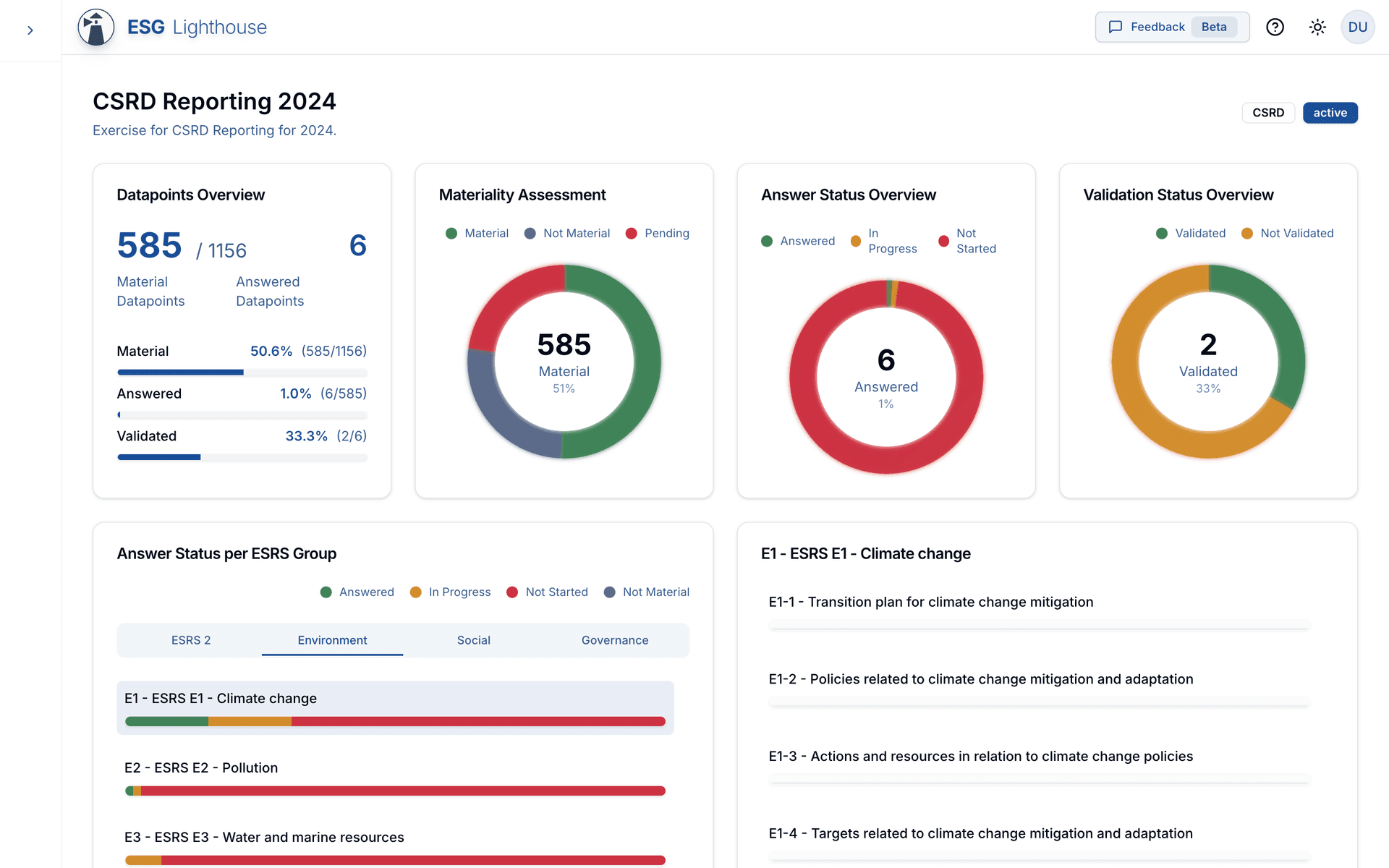
Each company's data is fully isolated with role-based permissions (admin, editor, viewer, auditor). Flows cover materiality assessment, parent-and-subsidiary roll-ups, rich-text narrative editing, evidence attachments, and a progress dashboard. Built solo end-to-end over eight months — research, design, code, infrastructure, customer development.
Validated with pilot SMEs at a 60% reduction in reporting time versus consultant-driven workflows. Acquired shortly after by a sustainability operator who absorbed the product into their compliance offering.
A pragmatic stack — selected to ship fast without trading away long-term operability.
11 tools
2 tools
2 tools
6 tools
4 tools
1 tool
Real-time AI guidance grounded in the official ESRS reference material. Every suggestion cites the originating paragraph of the standard — audit-ready, not made up.
500+ disclosure items made searchable through smart search and materiality flows, so users find the requirements that apply to them without reading the entire framework.
Each company's data is fully isolated, with role-based access (admin, editor, viewer, auditor) and per-project permissions. Designed from day one to serve many organisations on the same platform — without compromise.
Pilot SMEs cut reporting time by roughly two-thirds versus consultant-driven workflows — a combination of AI assistance, automated tracking of disclosure items, and a rich editor with evidence attachments.
The platform is more than structured CRUD over each ESRS KPI. From those KPIs plus whatever documentation the company uploads — PDF, Word, Excel, plain text — it generates the full sustainability report: a sector-aware double materiality assessment, drafted narrative sections, and a print-ready PDF where every claim is cited back to its source.
ESRS KPI entries and every uploaded document are parsed and split into short passages. Each passage keeps its origin — file, page, KPI — so anything that lands in the report can be traced back.
Passages become vector embeddings for semantic search, paired with a keyword (BM25) index for exact regulatory terminology. ESRS language is precise — hybrid retrieval catches both the concept and the wording. Indexes rebuild only when the source data changes.
An LLM scores every ESRS topic on impact and financial materiality, starting from a sector-informed baseline derived from the company profile — so each topic gets a defensible judgement even where documentation is thin. Material topics decide which report sections get depth.
For each section of the report blueprint, targeted retrieval queries assemble a fact pack: a curated set of evidence snippets, each carrying a source anchor. The model is allowed to write only from this pack — never from its general knowledge.
Each section is drafted by the LLM in deterministic, structured-output mode, with its fact pack as the only evidence. Every paragraph and table must carry citations; missing ones are flagged and backfilled before the section is accepted.
An automated QA pass catches uncited claims, empty sections, and schema drift. The report then renders to Markdown and a print-ready PDF, with footnotes mapping every statement back to the original document, page, or KPI.
Tap any screen to open the gallery — swipe, arrow keys, or click through.